What Is AEO and GEO? How They Work Together to Get Your Business Noticed by AI in 2026
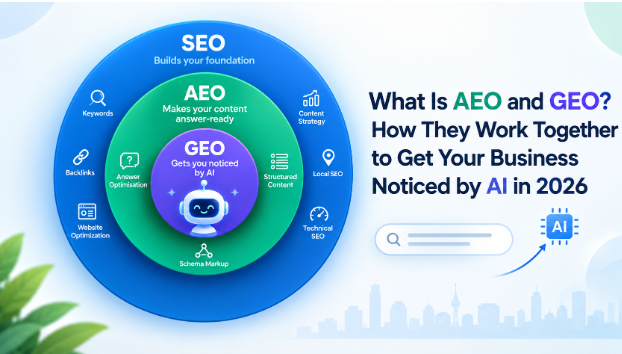
Table of Contents
- What Is AEO and GEO?
- What Is AEO (Answer Engine Optimization)?
- What Is GEO (Generative Engine Optimization)?
- AEO vs GEO vs SEO — The Real Difference
- How AEO and GEO Actually Work Together
- How AI Engines Decide What to Cite (Query Fan-Out, Explained)
- A Practical AEO + GEO Checklist for Your Business
- Common Myths About AEO and GEO
- How Cloud Dreams Approaches AEO and GEO
- FAQs
If you've searched "what is AEO" or "what is GEO" recently, you've probably landed on a dozen different explanations, half of them contradicting each other. That's because the industry itself hasn't fully agreed on the terms yet — but the underlying shift they describe is real, and it's already changing how customers find businesses.
This is the complete, plain-language explanation of both terms, how they relate to each other, and what to actually do about it.
What Is AEO and GEO? (Quick Answer)
AEO (Answer Engine Optimization) and GEO (Generative Engine Optimization) both describe the practice of structuring your content so AI systems — ChatGPT, Gemini, Perplexity, Google AI Overviews, Claude — cite, quote, or recommend your business directly in their answers, instead of just linking to your website in a results list. In practice, most in the industry now use "AEO" and "GEO" interchangeably to mean the same goal — getting cited inside an AI-generated answer. SEO (Search Engine Optimization) remains the separate, foundational discipline of ranking in a traditional list of links.
What Is AEO (Answer Engine Optimization)?
AEO focuses specifically on being the direct answer — the fact, definition, or recommendation an AI system pulls out and states clearly, often with attribution. It grew out of the earlier "featured snippet" era of SEO, extended to cover AI chat and voice assistants that answer a question in one sentence rather than showing a results page.
A page built for AEO typically:
- States the answer in the first sentence or two, before explaining further
- Uses clear question-and-answer structure (FAQs, "What is..." headings)
- Backs claims with specific facts, not vague marketing language
What Is GEO (Generative Engine Optimization)?
GEO is the broader term — it covers optimizing your entire content and brand presence so that generative AI engines (any system that uses a large language model to synthesise an answer from multiple sources, rather than list links) retrieve, cite, and recommend you.
The term originated from academic research: a Princeton-led study built a benchmark of roughly 10,000 real user queries and tested different content-optimization tactics against a Bing-Chat-style generative engine. The standout finding was that specific, targeted changes to content could increase a source's visibility inside generative AI answers by as much as 40% — and the tactics that worked best weren't always the ones marketers expected. That research is largely what gave the practice its name and turned it from an academic idea into a mainstream marketing discipline by 2026.
In short: GEO is the umbrella goal (be visible across generative AI systems); AEO is the specific technique most commonly used to achieve it (structure content as direct, citable answers). Most practitioners now treat the two as effectively the same day-to-day work.
AEO vs GEO vs SEO — The Real Difference
| Discipline | What it optimises for | Success measured by |
|---|---|---|
| SEO | Ranking position in a traditional list of search results | Rankings, organic clicks, traffic |
| AEO | Becoming the exact statement or fact an AI pulls into its generated response | Citation frequency, direct-answer inclusion |
| GEO | Overall visibility and citation across all generative AI platforms | Brand mentions and citations across ChatGPT, Gemini, Perplexity, AI Overviews, etc. |
Google itself has weighed in on this: in its 2026 documentation on optimizing for generative AI features in Search, Google's position is that optimizing for generative AI search is still fundamentally SEO — the same principles of quality, relevance, and technical soundness apply, just extended to a new output format. That's a useful reality check: AEO and GEO don't override SEO basics — they're layered on top of a site that already does SEO well.
How AEO and GEO Actually Work Together
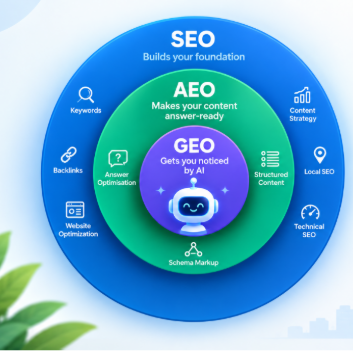
Think of it as three layers, each depending on the one below it:
- SEO (the foundation). Your site needs to be crawlable, fast, mobile-friendly, and properly indexed. An AI tool has no reason to reference a page it can't load quickly, crawl properly, or trust in the first place.
- AEO (the technique). On top of that foundation, you structure specific pieces of content — a definition, a price range, a comparison, an FAQ — as clean, self-contained, directly-stated answers.
- GEO (the outcome/goal). The cumulative effect of doing AEO well, consistently, across your site, plus building genuine topical authority and brand signals, is that generative AI engines start treating your site as a trustworthy source to cite — which is the actual business goal.
You don't "do AEO" and "do GEO" as two separate projects. You build genuinely useful, clearly-structured, technically sound content — and AEO/GEO are simply the lens for making sure that content is written in a way AI systems can use.
How AI Engines Decide What to Cite (Query Fan-Out, Explained)
One concept worth understanding: when someone asks an AI system a question, the AI usually doesn't just search for that exact phrase. It breaks the question into several smaller sub-queries — a process sometimes called "query fan-out" — and searches for each piece separately before combining the results into one answer.
This matters practically: a page that answers only the exact keyword you're targeting may get missed if the AI has fanned the original question out into related sub-questions your page doesn't address. Comprehensive content that naturally covers the surrounding sub-topics (definitions, comparisons, costs, examples, common mistakes) has a better chance of being retrieved across multiple fan-out queries — not just one.
A Practical AEO + GEO Checklist for Your Business
- Answer the question in the first sentence of any page meant to rank for a "what is..." or "how much does..." query
- Build genuine FAQ sections with specific, factual answers — not filler questions
- Use structured data (schema) — Article, FAQPage, Organization, BreadcrumbList — to remove ambiguity for AI crawlers
- Keep content fresh — recently updated pages are favoured for commercial and comparison-type questions
- Cover the sub-topics, not just the headline keyword, so your page can be retrieved across multiple fan-out queries
- Be specific, not promotional — real numbers and clear comparisons get cited; "industry-leading solutions" doesn't
Comparing AEO, GEO, and SEO: Where Each One Fits — Fix SEO fundamentals first — site speed, mobile-friendliness, and indexing still matter more than any AI-specific tactic
Common Myths About AEO and GEO
- Myth: "Schema markup alone gets you cited by AI." Reality: Structured data helps AI systems parse your page correctly, but it's the clarity and specificity of the actual written content that gets cited — not the markup by itself.
- Myth: "AEO and GEO make SEO unnecessary." Reality: Both are built on top of solid SEO. A slow, poorly indexed, untrustworthy site won't get cited regardless of how well the content is structured.
- Myth: "There's one universal AEO/GEO ranking algorithm." Reality: Each AI platform (ChatGPT, Gemini, Perplexity, Google AI Overviews) retrieves and cites sources somewhat differently — there's no single formula, and the field itself hasn't settled on consistent terminology yet.
How Cloud Dreams Approaches AEO and GEO
Cloud Dreams has built its SEO services around the technical fundamentals — schema markup, structured on-page content, keyword strategy, and site performance — that both classic search ranking and modern AI citation depend on. As AEO and GEO have emerged as distinct disciplines, that existing technical foundation means Coimbatore businesses working with Cloud Dreams are already closer to being AI-visible than they may realise.
Want your website reviewed for AI-search visibility, not just Google rankings? Get in touch with Cloud Dreams, a web designing and SEO company in Coimbatore, for a full review covering both.
FAQs
Q1: Is AEO the same thing as GEO?
Mostly, yes, in current practice. Both are aimed at the same outcome: having an AI tool pull your content into the answer it generates. AEO is often used for the specific technique (structuring direct-answer content); GEO is often used as the broader umbrella term. The industry hasn't settled on strict definitions, so you'll see them used interchangeably.
Q2: How is AEO/GEO different from SEO?
SEO is built around earning a spot in the classic list-of-links results page. AEO and GEO optimise for being the actual answer an AI system states or cites — with or without a click to your site. Neither AEO nor GEO can function without the underlying SEO basics already being solid.
Q3: Can a small business realistically get cited by ChatGPT or Gemini?
Yes — research on generative engines has found that specific, well-structured content changes can measurably increase citation visibility, and AI systems often favour clear, specific, up-to-date content over generic corporate copy, which can level the playing field for smaller, well-optimised sites.
Q4: Does adding schema markup guarantee AI citations?
No. Schema removes ambiguity and helps AI systems parse your page correctly, but the clarity and specificity of your actual written content is what determines whether it gets cited.
Q5: What is "query fan-out" and why does it matter for AEO/GEO?
It's the process by which an AI system breaks a single question into several smaller sub-questions and searches for each separately before combining the answer. It means your content should cover related sub-topics comprehensively, not just the exact target keyword.
Q6: What's a realistic timeframe for seeing AEO/GEO impact?
There's no fixed timeline, and unlike Google rankings, there's currently no standard tool to precisely track AI-citation position. The most practical approach is periodically testing your target questions directly in ChatGPT, Gemini, and Perplexity to see if your business appears.
About the Author
Cloud Dreams Team — Cloud Dreams has been designing websites and running SEO and digital marketing services for businesses in Coimbatore since 2011. This article was researched and written by the Cloud Dreams content team, drawing on the agency's day-to-day technical SEO work (schema markup, on-page optimisation, site structure) as the practical grounding for how AEO and GEO build on existing SEO practice.